
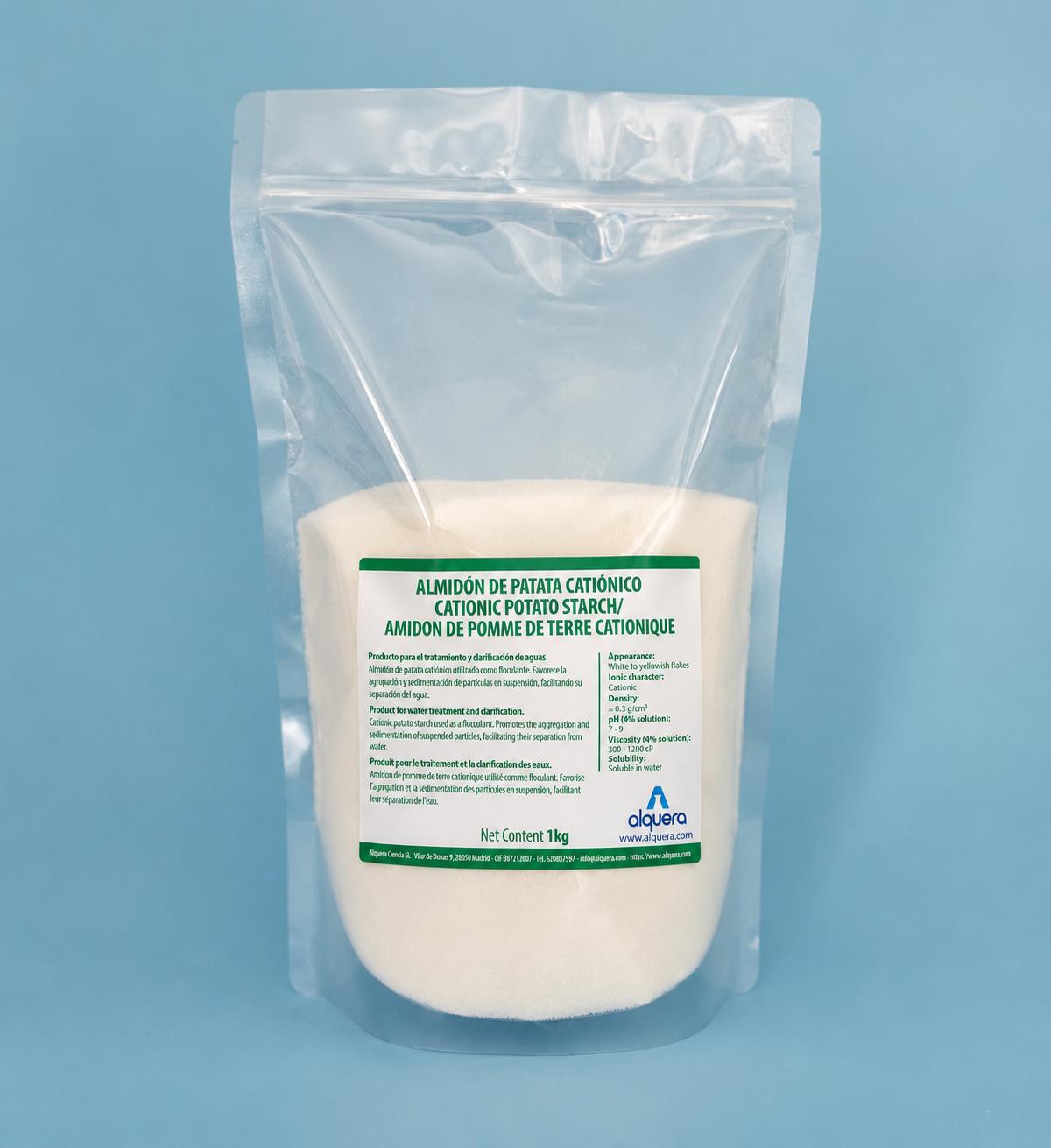
Modified potato starch can be used in water treatment as a natural coagulant-flocculant agent to help clarify water and remove suspended solids. New legal requirements for water treatment for human consumption have led to a new generation of products that allow for maximum efficiency while complying with the strictest regulations.
The nature of the starch: anionic or cationic starch depends on the characteristics of the raw water and the operating conditions of the plant. It is recommended to perform preliminary tests to evaluate its behavior in each application and optimize the treatment conditions.
IDENTIFICATION AND PROPERTIES OF POTATO STARCH
| Name | Modified and pregelatinized anionic potato starch | Modified and cationically pregelatinized potato starch |
|---|---|---|
| Synonym | Modified and pregelatinized anionic potato starch | Modified and cationically pregelatinized potato starch |
| CAS | Not indicated | 56780-58-6 |
| Appearance | Fine white-yellow powder | Solid in whitish-yellow flakes |
| Ionic character | ⊖ Negative charge | ⊕ Positive charge |
| Olor | Practically odorless | The fish smell is very faint |
| Density | Not indicated | ≈ 0.3 g/cm³ |
| pH (4% solution) | 10–12,5 Alcalino |
7–9 Neutral to slightly alkaline |
| Viscosity (4% solution) | 300–1200 cP | 300–1200 cP |
| Solubility | Soluble in water; the concentration is limited by the developed viscosity. | Not indicated |
BENEFITS USING POTATO FLOUR FOR POTABLE WATER
- It facilitates the flocculation processes in the treatment of waters intended for human consumption.
- It contributes to improving the separation and treatment of the sludge generated in the water treatment plants.
- It maintains its effectiveness over a wide range of pH values.
- It promotes the rapid formation and sedimentation of flocs, facilitating the separation of suspended solids.
PREPARATION AND DOSING AMYLOID WATER TREATMENT
- Before its application, it is advisable to prepare a solution of the product in water, taking into account that the maximum concentration will be conditioned by the viscosity reached. The product is pregelatinized, that is, it has been previously treated to allow it to swell and develop viscosity in cold water.
- To favor proper dispersion, it is recommended to incorporate the product gradually while maintaining intense and constant agitation.
- The product is soluble in cold water and allows the formation of colloidal dispersions.
- The stability of the solution can vary depending on factors such as water quality, pH, temperature, and concentration. Therefore, it is recommended to use the preparation within the hours following its preparation.
- To ensure optimal performance, it is important to determine both the appropriate dose and the most effective application point according to the treatment conditions.
ANIONIC AND CATIONIC FLOCULANT
When choosing the anionic – cationic flocculant, the difference lies in its electrical charge: the anionic has negative charge and the Cationic, positive. Both help to group particles to facilitate their separation from water.
Anionics are usually used in waters containing mineral solids and in physicochemical treatments. Cationics are commonly used to thicken and dehydrate biological sludges rich in organic matter.
The choice depends on the composition of the water, the pH, and the process used. Therefore, it is advisable to conduct tests with different doses to find the most effective product.
SEE MORE FLOCULANT PRODUCTS
You can consult all our flocculants in the category flocculant.
Reviews
There are no reviews yet.