
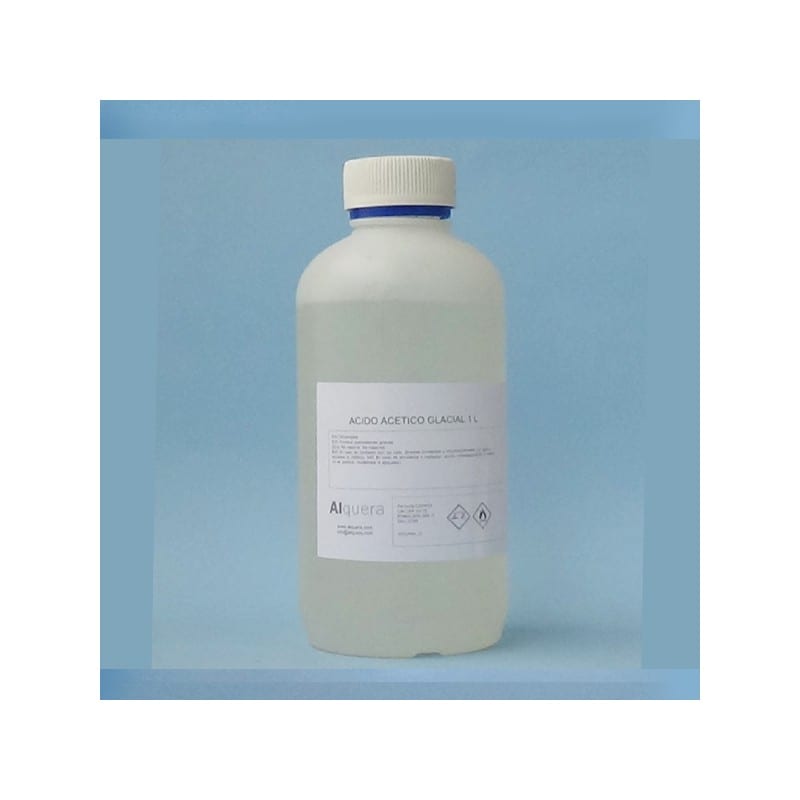
Glacial acetic acid is a naturally occurring acid and is found in most fruits. Its main production method is bacterial fermentation; therefore, it is present in all fermented products. This acid solidifies at 16.6ºC and is generally used in the production of acetates as a neutralizing agent, as an ingredient in adhesive compounds, as an ingredient in aircraft industry lacquers, among other uses. Glacial acetic acid refers to anhydrous acetic acid, that is, without the presence of water.
IDENTIFICATION AND PROPERTIES
Name: Acetic glacial acid
Chemical formulaC2H4O2
CAS: 64-19-7
EC: 200-580-7
ONU:2789
- Physical state: Liquid
- Colour: Colourless
- Odour: Characteristic
- Olfactory threshold: 480 ppm
- Freezing point: 17ºC
- Point/ Initial point/ Boiling point range: 118ºC
- Point of Inflammability: 39ºC
- decomposition temperature: 460-595ºC
- pH: <2 (100%)
- Kinematic viscosity: 1.01 mm2/s
- Solubility: Miscible with water
- Distribution coefficient (n-octanol/water)(logarithmic value): -0.17
- Steam pressure: 2084 Pa
- Absolute density: kg/m3 1044.6
- Relative density: 1.07
Uses and applications of glacial acetic acid
- Among the main applications and uses of glacial acetic acid are:
- Cleaning of stains
- In medicine, it is used as a dye in colposcopies. It helps in the detection of the human papillomavirus.
- It is used in histology (preservation of organs and tissues for study)
- Fixes nucleoproteins
- Manufacture of vinyl acetate, rayon, cellulose acetate, among others
- In beekeeping, it is used to control the moth pest in the wax.
Reviews
There are no reviews yet.